
Chapter 1
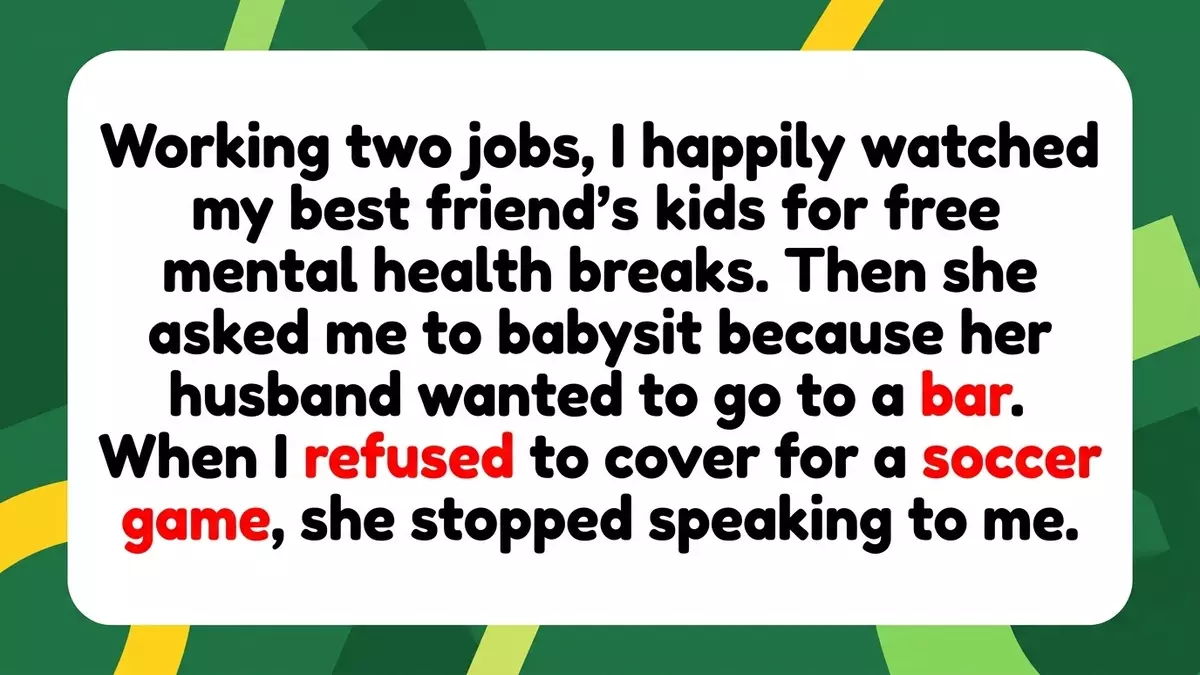
AITA For Refusing To Babysit My Best Friend’s Kids Just Because Her Husband Wanted To Watch A Soccer Game At A Bar?
We all know that heart-warming feeling when we gladly bend over backward to help a loved one in need. Sacrificing our own precious free time out of pure affection feels natural when a close friend is struggling. For one hardworking woman juggling two demanding jobs, supporting her best friend meant regularly rearranging her incredibly tight schedule to provide much-needed, free childcare.
She was more than happy to step in so her overstimulated friend could get a rare, quiet moment of mental health self-care. However, when a chronic pattern of last-minute schedule changes, late arrivals, and blurred boundaries pushes a generous friend to their absolute limit, a simple favor can quickly turn into a massive breaking point.
What started as a supportive gesture soon began to feel like a convenient loophole for the friend's household. When a weekend plan shifted from helping a stressed, burnt-out mother to covering a shift for a husband who simply wanted to watch a soccer game at a local bar, she finally decided to draw a hard line in the sand. The fallout was immediate and severe, leaving their long-standing friendship hanging in a tense, silent balance.
AITA For Refusing To Babysit My Best Friend’s Kids Just Because Her Husband Wanted To Watch A Soccer Game At A Bar
The Reality of the Domestic Imbalance: Enter the Overfunctioning Loop
The friction in this relationship did not develop overnight. Instead, it was fueled by the slow, insidious creep of minor inconveniences that we quietly tolerate until they suddenly become too heavy to bear. In this case, the dynamic closely mirrors a psychological phenomenon relationship experts describe as overfunctioning. This occurs when one well-meaning individual within a social system consistently overcompensates for another person's complete lack of participation or accountability.
Stressed Mom Asks for Help ──> Friend Constantly Overfunctions ──> Husband Departs for the Bar ──> Shielded from Domestic Duty
By stepping in to cover the couple's childcare so the husband could spend his afternoon socializing at a sports bar, the original poster was no longer just providing a compassionate safety net for her best friend. Instead, she was inadvertently shielding the husband from the natural, everyday consequences of his lack of domestic partnership. The favor stopped being an act of community care and transformed into an enabling mechanism for an uninvolved partner.
The Science of Burnout: Why 'The Village' Requires a Two-Way Street
The popular, long-standing concept of "it takes a village to raise a child" is meant to represent a beautifully reciprocal network of mutual support, shared labor, and community care. It was never intended to operate as a one-way street where a single, exceptionally busy friend is systematically exploited to enable a partner's personal leisure time.
According to prominent relationship authorities, including licensed therapist Nedra Glover Tawwab, LCSW, establishing firm, unyielding limits is actually an active act of love that preserves the longevity of relationships rather than destroying them. When we consistently fail to voice our discomfort with how our time and energy are treated, we don't fix the problem; we simply build a silent, toxic reservoir of internal resentment. This resentment eventually erupts during a single, highly charged conflict over an issue that the other party perceives as minor.
Furthermore, behavioral research published in the Journal of Experimental Social Psychology indicates that when personal boundaries are crossed repeatedly without clear consequences, a dangerous shift in perspective occurs:
The boundary-crosser naturally begins to view the other person’s ongoing compliance as a default expectation or an absolute right, rather than a generous, elective gift.
This psychological shift explains precisely why the best friend reacted with such intense defensiveness and anger when met with a refusal. Because the favor had been normalized into a routine obligation, the sudden enforcement of a personal boundary felt to her like a personal rejection and a breach of contract, rather than a friend reclaiming her own mental health space.
Public Verdict: Internet Forums Unanimously Reject the Guilt Trip
When the details of the babysitting standoff were shared on popular online community forums, the public response was swift and overwhelming. The digital community rallied decisively behind the original poster, delivering a resounding "Not the Asshole" (NTA) verdict while forcing the family to confront a few uncomfortable truths:
-
The Entitlement Audit: Commenters overwhelmingly pointed out that a husband's desire to watch a sports match at a commercial bar does not constitute a childcare emergency. Demanding a friend who works two jobs give up her solitary weekend rest to cover that slot is a symptom of deep entitlement.
-
The Weaponization of Guilt: The best friend's subsequent silent treatment was heavily condemned as an unfair manipulation tactic designed to make the poster feel guilty for prioritizing her own occupational fatigue.